PDA and PDA Burnout
Although considered by most as an Autistic profile there are those of us who do not see PDA in this way and believe it is in fact a separate ‘neurotype’. It has been known about since the early 1980s and the term was introduced by Elizabeth Newson, describing it as ‘resistance and avoidance of the everyday responsibilities, even when it is beneficial for them to comply’. A PDA individual might share a lot of the same characteristics that lead to a person being identified as Autistic, but there are some very distinct differences. Things such as routines and structures that are assumed will support the person might actually be strongly resisted and avoided, especially if they are not from the person themselves or involving them and they can be experienced as demands.
Known as ‘Pathological demand avoidance’ but many prefer ‘persistent drive for autonomy’, ‘pervasive demand for autonomy’, or even ‘persistent desire for authenticity’ (Dr Joey Lawrence). A PDAer has a very highly sensitive nervous system that reacts strongly to any loss of physical, psychological or emotional autonomy. They experience avoidance and resistance of anything that is experienced as a demand and this includes internal as well as external demands, both can be experienced as a threat because the nervous system reads them as a loss of autonomy. They also do not feel safe within any hierarchical systems, where they might experience a constant sense of not having agency and equity.
Many PDAers can be more internalised and might not express their distress of losing autonomy outwardly, but rather might turn in against themselves. Their distress might show up in some individuals as self harm, eating related issues or even addictions, etc. They might not show their deep distress in the same way as a PDAer who is externalised but they will be feeling equally as unsafe. SOme PDAers can be internalised as well as externalised.
Their avoidance might be expressed in various ways, such as what are known as social strategies: feigning illness or injury, fibs, excuses, lying, fantasy, delaying, diverting or even making threats. What might seem like defiance and non-compliant behaviour is actually the sign they are extremely distressed, anxious and scared. PDAers can also be very other people focussed (real or imagined) which might become overwhelming and for some this can sometimes become obsessional. A PDAer’s sense of fairness, equity and justice sensitivity can be overwhelmingly intense and can be something they experience about other people as well as regarding themselves. They can be absorbing
the emotions of others in an environment like a canary in the coalmine which can be exhausting for them.
Many mistakenly think PDA is about wanting control over people, being oppositional and vindictive; this can mean many are misdiagnosed with Oppositional defiance (ODD) or a conduct disorder. People who are Black are still disproportionately more likely to be misdiagnosed with ODD rather than PDA or also other neurodivergence such as ADHD.
PDAers are very independent thinkers, having their own agenda from a young age. Due to their sensitive nervous system and often feeling unsafe within themselves they may often need the safety from connection with a trusted and safe person, which for a child might be one of their parents in particular. There might only be a few people they trust and feel safe or safer with. Despite being more socially driven a PDAer can struggle to ‘find their place’ in a social hierarchy, including within a family, with friends and within society. This is mostly due to the need for a level playing field and for there to be fairness and justice. For some PDAers role-playing, being a person, character or role they play, may feel safer than being themselves. Children might become an animal in role-play for example..
PDAers can be in a near constant state of hypervigilance, regularly experiencing fight, flight. This is often because an environment where they spend prolonged periods of
time, the systems and the people within them are inadvertently (usually) taking their autonomy. There is a huge cost for the PDAer and can mean they not only experience burnout but may be more likely to experience chronic burnout.
Some common PDA experiences

•A very strong, persistent and permanent need for autonomy in everything and having their own agenda from young
•Avoidance, resistance of anything experienced as a demand, even everyday demands. Avoidance and resistance may be expressed in various ways such as what are known as social strategies - feigning illness or an injury, fibs, excuses, fantasy, delaying, diverting or making threats.
•PDAers have a very sensitive autonomic nervous system – they experience a fight/flight/freeze response in the face of demands. Demands are a threat
•Some PDAers might role-play - being a person, character, animal or role they play may feel safer being than being themselves.
•Might be sociable and may engage well in social situations, might be very articulate, giving good eye contact, but may lack depth, being a ‘social butterfly’.
•They are more likely to be focussed on other people (real or imagined) with possible obsessive behaviour
•Can struggle to ‘find their place’ in a social hierarchy including within a family, with friends and in society. This is due to the need for a level playing field where they have equity, agency and autonomy.
•Routines and structures might be strongly resisted and avoided, especially if they are not from them or involving them; they can be experienced as demands and expectations.
•They can experience panic and big mood swings that can turn into meltdowns. This can be due to a perceived or actual loss of autonomy.
•They can experience a constant state of hypervigilance with others. There might only be a few people they feel safe or safer with.
Externalised and internalised equalising
Many assume that PDA means that resistance and open refusals and avoidance will always be on display for the world to see, often leading to accusations of being controlling and manipulative. But for some their experience is internalised and may be completely missed, meaning their need for autonomy and for a level playing field is missed also. They might be very complaint and keep it all inside, they won’t express their deep distress in the same way as a PDAer who is in a fight, flight state, but they will be feeling equally as unsafe in a freeze or fawn state for example. Being externalised or internalised is not fixed state, PDAers might experience both.

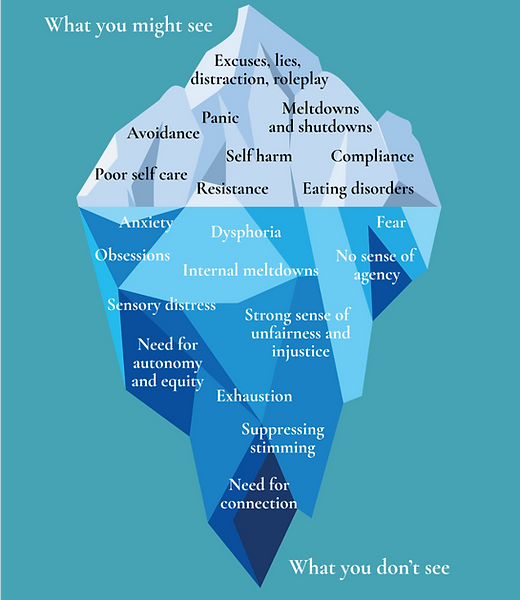
Hierarchy and autonomy
Hierarchical structures and systems very often do not work for PDAers and can lead to them experiencing extremely high levels of stress and anxiety. They can find it hard to find their place in these systems, even within a family, which can lead to masking in order to survive due to not feeling safe in themselves.
PDAers might well fully understand ‘authority’ and ‘hierarchy’ but their need for fairness and justice can lead to a very strong threat reaction in the face of these things. If there is any sense of hierarchy is detected then this can lead to them strongly pushing back due to the sense of injustice, a loss of equity, control and agency. The result can be what we call equalising. Equalising can look like exerting power and control but it is a subconscious response and not a conscious decision to punish other people, in fact it might well be something some wish they could stop doing. Internalised PDAers may turn this equalising in on themselves which can lead to self harm, eating disorder, stopping talking, suicidal ideation, etc.
Other people may be confused or offended by their anger and what might also be aggression and they might up the anti and increase the demands and expectations of them, believing that this will make the individual come in line and comply. This is likely to lead to the PDAers nervous system seeking safety and they might end up trying to get back autonomy - by any means.
More about equalising can be found here: https://www.rabbishoshana.com/post/what-is-equalizing-and-what-s-the-difference-between-equalizing-and-abuse


Demands
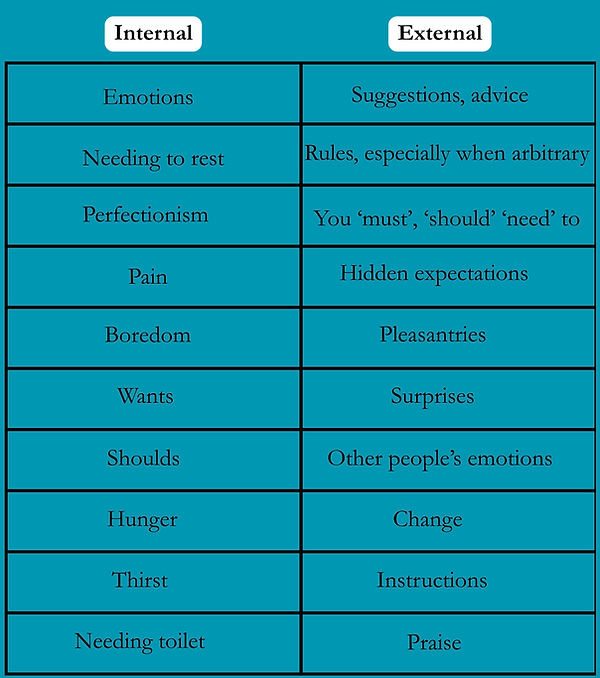
Demands can be anything where for example a response is expected, anticipated or insisted upon. These can be everyday things that a non PDAer might take for granted. The demands themselves are experienced by the PDA nervous system as a threat, as danger and the survival brain (limbic system/amygdala) is triggered to keep the individual safe. The demands that lead to this response are different for every PDAer, we are not carbon copies of each other.
Internal demands - which may be self imposed such as perfectionism, the inner critic, 'shoulds and musts', but also interoception signals from body
External demands - which may be direct, subtle, hidden expectations, societal or from family and friends

PDA Burnout


Some of the main causes of PDA burnout

-
Too many demands – these might be internal such as perfectionism, shoulds and wants and internal signals as well as external demands such as arbitrary rules, expectations or structure. Because PDA is wrongly considered by many to be an Autistic profile, many might think they need the same kind of adjustments you would out in place for an Autistic person, whereas quite the opposite is the case.
-
Living in survival mode - masking in order to survive because of what are neuro-normative expectations. Neuronormativity says ‘this is the normal way to present yourself, to communicate, to socialise, to play, to be distressed, to think, to feel emotions and so on.
-
No or not enough autonomy and agency – that gives the freedom to make their own choices. When a PDAer does not have agency to be able to think for themselves and make their own decisions and when there is hierarchy and unilateralism within a family structure or system, a PDAer can struggle to know where they fit.
-
Hierarchical systems where there is an imbalance of power which means that for example a very high percentage of PDAers find school environments extremely challenging and also a high percentage are self employed.
-
Sensory overload - which is traumatising and gradual exposure to it DOES NOT reduce the impact of sensory input.
-
Other people’s emotions – PDAers are sensitive to all the energy and emotions experienced by others. They are absorbing all that energy and this is extremely stressful and dysregulating. They might not be showing their distress in the way you expect, it might not be written on their faces but nonetheless it is happening internally.
-
Perfectionism. This can be common in many neurodivergent people. For PDAers the thing about perfection is that when something feels perfect then this can feel it is under control. Perfection can be a strong driver but it is a cruel task master and exhausting.

Parents wanting help understanding PDA and PDA burnout/recovery, I have a plan just for you
